You don’t have to be tired of sitting as you get older. Many people think that after the age of 65 they will loose the ability to stand from sitting. However with the correct seating you can remain independent for longer.
Understanding the mechanics of supportive seating
Supportive seating tackles three key problems: the effort to sit down, the pressure on the body whilst seated and the force required to stand up. Most chairs have a very low seat height which requires a lot of leg strength and balance to get up from. This can be a particular problem for the elderly or less able. As people get older their joints become stiffer and muscles weaken making it increasingly difficult to manage tasks like sitting down and getting up from a chair.
I did this in the second iteration. Raising the starting point with supportive seating makes a HUGE difference.
The seat height of the standing stool should allow you to stand comfortably with your feet flat on the floor, with your knees at about a 90-degree angle. Some people prefer to stand with a slightly higher stool position, reducing the angle of their knees. While having the stool at the correct height is important, the angle of the seat itself must also be taken into account. Giving the seat a forward tilt will help to shift your body weight forward, and also make it easier to stand up from the stool.
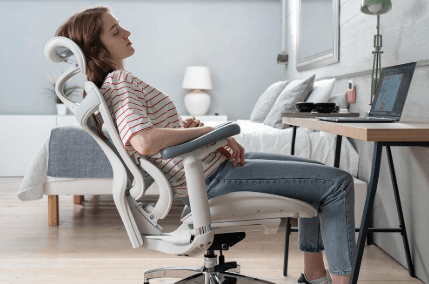
Height and depth of armrests are important, you want them to provide enough leverage without forcing you into an awkward position with your shoulders. Height is the biggest problem, either the armrests are too high making you sit in an uncomfortable upward position or too low providing little leverage. The width between armrests is also important, you want to have enough room to sit comfortably between them but enough room to generate enough force to slowly stand up.
While back support is a key feature for any office chair, it becomes even more important when considering use for extended periods of time sitting. Having a comfortable backrest that allows you to sit in a natural posture, prevents slouching and reduces discomfort or stiffness.
How assistive technology transforms everyday seating
While modern assistive seating has focused on helping individuals with mobility issues to move from a seated to standing position, or vice versa, the ultimate in assistive seating is the lift chair. Not only do you get the comfort of a recliner, but with the touch of a button, you are lifted up (either partially or completely) and the chair, including both the seat and back, is raised to a fully standing position, all without you having to expend any energy at all.
Most of the mechanisms operate slowly, and are remotely controlled using hand held transmitters. At any time, the remote operation can easily be stopped.
For many users the ‘half way house’ to full electric enabled toileting would be a spring or gas assisted toilet, commonly known as a ‘spring up’ or ‘easy up’ toilet. These toilets have a seat that is lifted by internal springs or gas cylinders as the seat returns to its forward most position, making it much easier to stand up than with a standard toilet. Whilst they do not offer quite the same level of assistance as a fully electric enabled toilet, they can make a huge difference to someone who needs to use a toilet, providing just enough assistance to allow independent toileting without the need for assistance.
A further feature of many office chairs that is not always immediately appreciated is the ability to swivel the chair at an angle before you even rise from the seat. This prevents any awkward twisting which could put you under strain, cause pressure on your joints or make you unstable.
See also: Green Home Design Trends for the Future
Selecting the right features for individual needs
Choice of supportive seating is often restricted by the range of available options. However, an appropriate wheelchair seating option is ultimately dependent on the disability of the user and their living situation. A good quality high-backed wheelchair chair with fully height adjustable rigid or adjustable armrests may be sufficient for someone with moderate disability, whilst someone with greater disability may require powered seating features. It is important to select seating on the current abilities of the user, rather than making assumptions about future abilities which are unknown.
Choose your recliner based on your needs. If you are going to be sitting and reading a book, this recliner will function differently than the recliner of a “couch potato” who only gets up to flip the TV remote control versus the recliner of someone who only uses it for a few minutes of rest between other activities throughout their day.
In some models some buttons are dedicated to positions for reading, TV viewing or sleeping. These can be useful in certain situations but crucial is that their remote control operation be simple to use by someone managing a cognitive impairment as well as by someone living with dexterity impairments due to arthritis of the hands. While adding some extra features might sound beneficial, ultimately they can end up causing more hassle than benefit. Lift chairs with intuitive controls are particularly important for users with limited mobility or cognitive challenges.
Placement and environmental considerations
When not in use chairs should be placed on level floor space with adequate space behind and to the sides of the chair for safe operation of the lifting mechanism. The space between the reclined chair and the wall will depend on the model of chair but this is usually approximately 150-200mm.
We also offer electrical access options to powered chairs. This option allows you to safely place the power cord of the chair. Some chairs contain a battery backup, but on an average you can expect no more than 10 to 20 transfers on a full charge.
Long-term benefits and maintenance
Although quality supportive seating may seem expensive at first, it is a fantastic investment in independence that can bring returns for a long time. There are also many psychological benefits associated with supportive seating, and when someone who is normally confined to a bed is able to move around the house in a recliner, they are more likely to engage in activity and therefore improve their health.
The fear of the chair can be so overpowering that this is sometimes a feature of the reluctance to use a chair that only manifests itself AFTER you have removed the chair from your home, and you can finally sit down and enjoy the chair just sitting there on the seat and not precariously perched on the floor balanced on the edge.
Other than regular cleaning and periodic greasing of moving parts, there is little else for you to do to maintain most modern assistive chairs. Motor warranties run for a minimum of 5 years. The main factor in ongoing maintenance will be the supplier and the level of service and support they can offer, as with the occasional parts failure, you will need to know about local repair facilities.